
Police Department

City of Morris Police Department
PH: 815-942-2131
F: 815-942-2853
The Mission of the Morris Police Department is to provide a safe, discrimination-free environment for all the people of our community.
The Morris Police Department is committed to:
- Developing and maintaining partnerships with the community.
- Providing responsive and personalized police services.
- Detecting and apprehending criminal offenders.
- Maintaining the highest degree of integrity and professionalism by our actions.
- Employing proactive policing strategies.

About the Department
Personnel Roster
Organizational Chart - Command Protocol

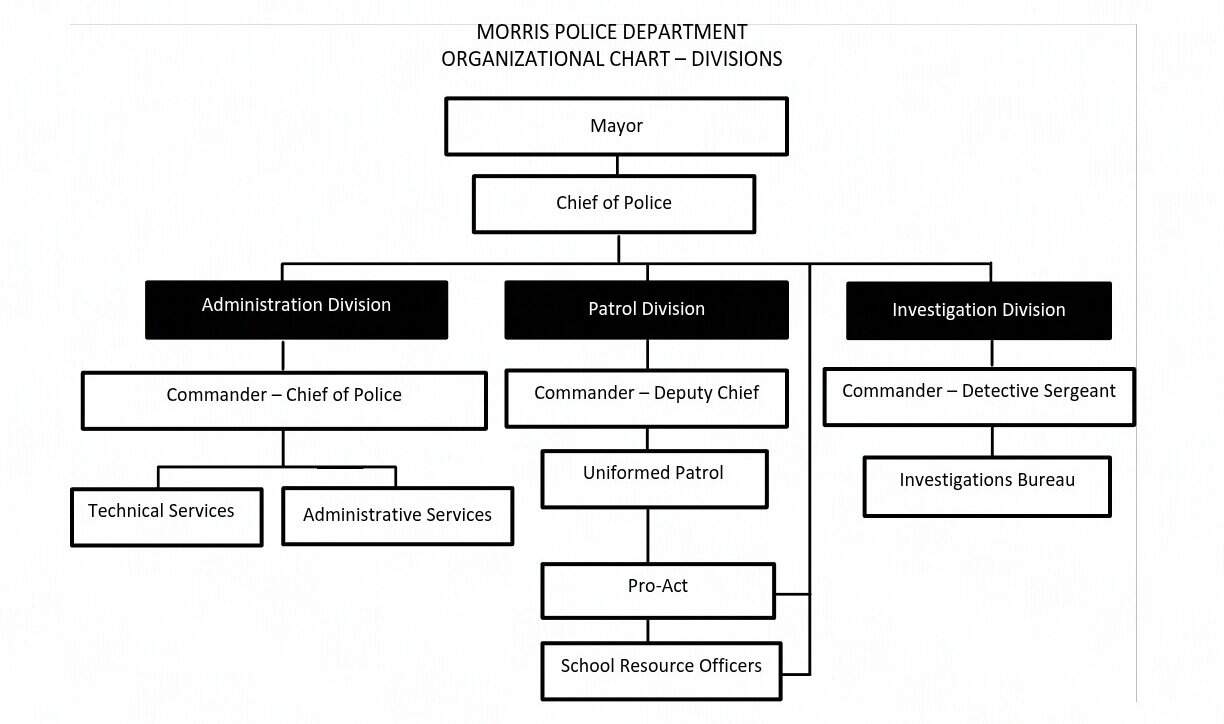
Organizational Chart - Divisions
Department Services & Support
Security Check Request Form
[email protected]
Morris Police Department
200 E. Chapin St.
Morris, Il 60450 Monday – Friday 8:30 am – 4:00 pm
Request Public Records (FOIA)
Freedom of Information Requests may be made:
Records Department of the Morris Police Department
Requesters submitting a FOIA request in person, by mail, or by fax are encouraged to use the FOIA Request Form available on our website or at the Records Counter of the Morris Police Department. Responses may still be provided electronically, if requested.
Effective January 1, 2026, pursuant to an amendment to Section 3(c) of the Illinois Freedom of Information act, all electronic FOIA requests must be submitted in full within the body of the email. This means the details of your FOIA request must appear in their entirety within the body of the email. As a cybersecurity measure and pursuant to Section 3(c), the Morris Police Department will not open or review attachments or hyperlinks; any such content will not be considered part of a request.
Information required for any FOIA request must include:
(As defined in the Illinois Freedom of Information Act (5 ILCS 140/2(c)10), it is a violation of FOIA to knowingly obtain a public record for a commercial purpose without disclosing that it is for a commercial purpose.)
Requests for Illinois Traffic Crash Reports:
Request Information by FOIA
The Illinois Freedom of Information Act, or Illinois FOIA is a series of laws designed to guarantee that the public has access to public records of government bodies at all levels in Illinois. The law was first enacted in 1984.
The latest law was enacted in August 2009, and went into effect on January 1, 2010. The Illinois FOIA is based on an assertion in the statute that access to “full and complete information regarding the affairs of government” is “necessary to enable the people to fulfill their duties of discussing public issues fully and freely, making informed political judgments and monitoring government to ensure that it is being conducted in the public interest.”
Below is link to the text of the Freedom of Information Act itself as provided by the Attorney General’s Office Website:
Illinois Freedom of Information Act
To read all FOIA General Information download the following:
For specific information, download the individual .pdf links below:
General Information
FOIA Request Form
Summary of Budgets
Police Commission
Index of Records Available for Immediate Disclosure
Index of Available Records
Background Checks and Subpoenas
Subpoenas, local background checks and other governmental requests for records can be submitted by:
By to:
815.941.5237
Email to
[email protected]
Mail or drop off in person:
Morris Police Department
200 E. Chapin St.
Morris, Il 60450
Monday – Friday 8:30 am – 4:00 pm
MPD Cares
The Morris Police Department is proud to introduce a program in collaboration with Trinity Services and Special Connections of Grundy County called MPD Cares. MPD Cares helps residents with special needs (mental and physical disabilities, mental illness, dementia, Alzheimer’s or anyone that may be at risk of becoming confused, disoriented, lost or missing) and their family members communicate their needs to first responders to better equip them in an emergency.
MPD Cares is designed to provide the Morris Police Department with the necessary information that will allow them to make faster identifications, reunite family members quicker and provide help to persons with special needs appropriately, effectively and without delay.
The police will collect and store current photographs, emergency contact information and other personal information relevant to the special needs of the individual. The information contained in this database is used only for emergency responders in the purpose of identifying and locating an individual who is reported missing or found wandering.
The police will collect and store current photographs, emergency contact information and other personal information relevant to the special needs of the individual. The information contained in this database is used only for emergency responders in the purpose of identifying and locating an individual who is reported missing or found wandering.
The Morris Police Department, at the direction of Chief Steffes, continues to send officers to “Crisis Intervention Team” (CIT) training. CIT training is an intense 40 hour training in which officers learn de-escalation tactics, personal interaction skills for varying needs, scenario based training and more. The Morris Police Department currently has 22 CIT trained officers and all officers are trained in Mental Health/De-Escalation training.
If you are interested or have a family member interested in participating in this program or have additional questions please contact the front desk or email: [email protected].
Community Camera Program
Flock Community Camera Program – Together We Make Morris Safer.
This program helps first responders respond faster and more efficiently during emergencies by providing secure, quick access to cameras throughout the community. By registering your residential cameras*, or integrating your business’ live feed cameras, you’ll help enhance emergency preparedness and incident response in our community.
*Residential cameras are not eligible for live feed connection. Registering residential cameras simply informs public safety entities that a camera is present at this location and who to contact to request camera footage .
Links to resources
Purchase Accident Reports
Pay Ordinance Tickets
Credit Bureaus:
Equifax 800-525-6285
Experian 888-397-3742
Transunion 800-680-7289
Illinois Sex Offender Information
Internet Crime Complaint Center
Dresden Nuclear Plant Public Safety Information
U-Visa & T-Visa Information
Voices Act
What is the VOICES Act?
The Voices of Immigrant Communities Empowering Act, also known as the VOICES Act, became effective January 1, 2019, after the Public ACT 100-1115 was passed. The VOICES Act allows “victims of qualifying criminal activity” to request a law enforcement certification form required by federal immigration law certifying that a person is a victim of qualifying criminal activity for use in applying for a U or T- Visa under the United States Code.
What is a U Nonimmigrant Visa (also known as a U Visa)?
The Victims of Trafficking and Violence Protection Act (VTVPA) of 2000 was enacted to strengthen the ability of law enforcement agencies to investigate and prosecute serious crimes and trafficking in persons, while offering protections to victims of such crimes without the immediate risk of being removed from the country. A U-Visa is a temporary visa issued by the United States Citizenship and Immigration Services (USCIS) to victims of certain crimes, providing temporary legal status and eligibility to work in the United States for up to 4 years.
Who is eligible for a U Visa?
USCIS may find an applicant eligible for a U Visa if the applicant:
- Is the direct or indirect victim of qualifying criminal activity;
- Has suffered substantial physical or mental abuse as a result of having been a victim of criminal activity;
- Has been helpful, is helpful, or is likely to be helpful to a Federal, State, or local prosecutor, to a Federal or State judge, to USCIS, or to other Federal, State, or local authorities investigating or prosecuting criminal activity; and
- The criminal activity violated the laws of the United States or occurred in the U.S. or the territories and possessions of the United States.
Additional information, including applicable forms, may be found through the U.S. Citizenship and Immigration Services here.
Qualifying Criminal Activities
The following are qualifying criminal activities: Rape; torture; trafficking; incest; domestic violence; sexual assault; abusive sexual conduct; prostitution; sexual exploitation; female genital mutilation; being held hostage; peonage; involuntary servitude; slave trade; kidnapping; abduction; unlawful criminal restraint; false imprisonment; blackmail; extortion; manslaughter; murder; felonious assault; witness tampering; obstruction of justice; perjury; fraud in foreign labor contracting; stalking; any similar activity where the elements of the crime are substantially similar; or the attempt, conspiracy, or solicitation to commit any of the above and other related crimes. Additionally, crimes that are “substantially similar” to those listed above may also qualify.
Not many people are aware that the unauthorized practice of law could be a qualifying criminal activity for purposes of U Visa certification. This problem occurs when immigrants go to a notary public seeking legal advice, and these notary publics file fraudulent claims. Many unsuspecting consumers of immigration services fall prey to “consultants” and notary publics who hold themselves out as legal professionals and falsely claim that the immigrant is eligible to legalize their immigration status. The unauthorized practice of immigration law occurs when those who are not attorneys or accredited representatives:
- Provide legal assistance to applicants or petitioners in immigration matters;
- Charge more than a nominal fee; and/or
- Hold themselves out to be qualified in legal matters.
The following are possible crimes associated with the Unauthorized Practice of Law: blackmail; extortion; obstruction of justice; perjury; witness tampering; or attempts or conspiracies to do any of the above.
Submitting U Visa Certifications (USCIS Form I-918, Supplement B) to the Morris Police Department
Please follow the following procedures prior to submitting a U-Visa Certification request to the Morris Police Department:
- Verify that the case in question was handled by the Morris Police Department. If the case was not investigated by the Morris Police Department, then we are not the correct office to handle your certification request. You may wish to request a copy of the police report and/or investigative report through the Freedom of Information Act, the process for which is detailed here.
- Verify that you or your client was a victim of a qualifying crime. See 8 CFR §214.14 (a)(9).
- Verify that you or your client was helpful in the prosecution of the case, specifically, your client has not refused to provide information reasonably requested by law enforcement and/or the respective Prosecutor’s office.
- Download the U-Visa law enforcement certification at U-Visa (USCIS Form I-918 Supplement B)
What is a T Nonimmigrant Visa (also known as a T-Visa)?
T nonimmigrant status is a temporary immigration benefit that enables certain victims of a severe form of human trafficking to remain in the United States for up to 4 years if they have assisted law enforcement in an investigation or prosecution of human trafficking. T nonimmigrant status is also available for certain qualifying family members of trafficking victims. T nonimmigrants are eligible for employment authorization and certain federal and state benefits and services. T nonimmigrants who qualify may also be able to adjust their status and become lawful permanent residents (obtain a Green Card)
Congress created this status (commonly referred to as a T visa) in October 2000 as part of the Victims of Trafficking and Violence Protection Act. Human trafficking, also known as trafficking in persons, is a form of modern-day slavery in which traffickers use force, fraud, or coercion to compel individuals to provide labor or services, including commercial sex. Traffickers often take advantage of vulnerable individuals, including those lacking lawful immigration status. T visas offer protection to victims and strengthen the ability of law enforcement agencies to investigate and prosecute human trafficking .
Under federal law, a “severe form of trafficking” is:
- Sex trafficking: When someone recruits, harbors, transports, provides, solicits, patronizes, or obtains a person for the purpose of a commercial sex act, where the commercial sex act is induced by force, fraud, or coercion, or the person being induced to perform such act is under 18 years of age; or
- Labor trafficking: When someone recruits, harbors, transports, provides, or obtains a person for labor or services through the use of force, fraud, or coercion for the purpose of involuntary servitude, peonage, debt bondage, or slavery. Additional information, including applicable forms, may be found through the U.S. Citizenship and Immigration Services here.
Download the T-Visa law enforcement certification at T-Visa (USCIS Form I-914 Supplement B)
Submitting U Visa Certifications (USCIS Form I-918, Supplement B) and T Visa Declarations (USCIS Form I-914. Supplement B) to the Morris Police Department
To submit a request for a T or U Visa certification to the Morris Police Department, or to appeal a denial of a certification request, please forward your request in writing with all supporting documentation to:
Morris Police Department
Attn: Office of the Chief of Police
200 E. Chapin St.
Morris, Il 60450
815-942-6503
To avoid a delay in processing your initial request or appeal, all U-Visa or T-Visa Law Enforcement Certification Requests or appeals must be mailed to the Office of the Chief of Police with all supporting documentation including Morris Police Department case report number if known. Supporting documentation includes but is not limited to:
- Name of Victim of Qualifying Crime
- Name of Arrestee/Defendant(s)
- Date of Birth and Identifiers for Arrestee/Defendant(s)
- Grundy County Court Case (docket) number if known
- Address of Incident
- Date of Incident
- Victim/Client’s Name and Identifiers
- A copy of the Police Report (obtainable through FOIA) will assist in processing the certification request
- Return Addressed Envelope with pre-paid postage affixed should be included with the submission
- Additional information can be located here.
Traducción
Instrucciones en Español:
Computadora de escritorio o portátil
Para ver páginas web en otro idioma, la mayoría de los navegadores ofrecen opciones fácilmente disponibles. Los navegadores Google Chrome y Microsoft Edge proporcionan traducción in situ. Para utilizar:
- Haga clic derecho en la página
- Seleccione “Traducir al idioma”
Las opciones de menú adicionales disponibles le permiten elegir entre muchos idiomas
También puede optar por ajustar completamente la configuración de idioma de su navegador para el idioma que prefiera usar. Consulte la sección de ayuda de su navegador para obtener instrucciones sobre cómo cambiar el idioma. Estas son las instrucciones para algunos navegadores comunes:
Chrome
Microsoft Edge
Firefox
iOS
Safari
Dispositivo móvil
iPhone
- Haga clic en el ícono Configuración (Settings)
- Busque su navegador preferido en la lista y haga clic para abrir la configuración del navegador
- Haga clic en Idioma en la sección “Idioma preferido” para cambiar
Androide
- En tu dispositivo Android, toca Configuración > Google > Administrar tu cuenta de Google
- En la parte superior, toca Información personal
- Desplázate hasta “Preferencias generales para la web”
- Toca Idioma > Editar
- Busca y selecciona tu idioma preferido
- En la parte inferior, toca Seleccionar